Use * syntax for faster search
Page History
| Section | |||||||||||||||||||||||||||
|---|---|---|---|---|---|---|---|---|---|---|---|---|---|---|---|---|---|---|---|---|---|---|---|---|---|---|---|
|
Overview
All Buyer Cloud customers have one or more unique seat IDs for configuring deals with SSPs. Your seat ID is passed in bid requests by SSPs and indicates that a deal is specific to your Buyer Cloud account or buzzkey.
| Anchor | ||||
|---|---|---|---|---|
|
Seat IDs can be accessed one of two ways, through the Admin module.
Access Seat IDs in Admin Module Dropdown
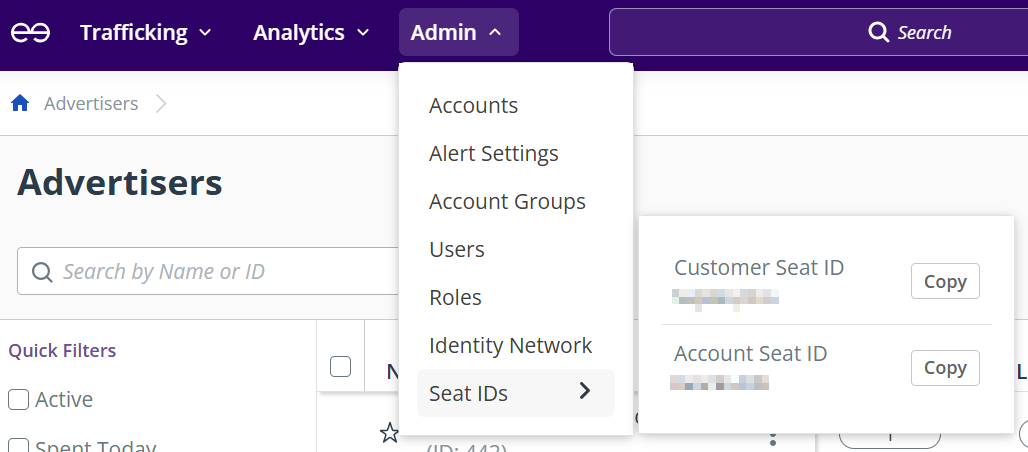
To view Customer and Account Seat IDs:
- Hover over Seat IDs in the Admin module dropdown.
- Select Copy next to a Seat ID to copy the seat ID to your clipboard.
Note that the Account Seat ID shown is for the current account you are in, which is viewable at the top right of the navigation ribbon.
Access Seat IDs in an Accounts Page
To view your seat ID(s), do the following:
- Go to Admin > Accounts.
- Open your account details page by doing one of the following:
If you have one Buyer Cloud account, select the Name & ID field in the list view.
If you have multiple Buyer Cloud accounts, select the Name & ID field of the desired account. - On the Overview Tab, the Customer Seat ID section (and Account Seat ID section, if applicable) is located at the bottom of the page.
Seat Types
There are two types of Seat IDs to use for configuring deals, explained below:
| Seat Type | Description | Usage |
|---|---|---|
| Customer Seat | Every customer receives a unique Customer Seat ID. | Use the Customer Seat ID when all accounts under one customer are eligible to bid on a deal. |
| Account Seat | Customers with more than one account also receive a unique Account Seat ID per account. Customer with only one account only receive a Customer Seat ID. | Use the Account Seat ID when only a specific account is eligible to bid on a deal. |
| Anchor | ||||
|---|---|---|---|---|
|
On February 10, 2026, Buyer Cloud introduced a new seat taxonomy:
| Time Frame | Description |
|---|---|
Before February 10, 2026 Legacy seat taxonomy | By default, customers used a default Buyer Cloud seat, with individual customer seats available upon request. Legacy seats (both the default and customer seats) were SSP-specific, making seat management challenging because customers had to manage a different set of seat IDs per SSP. |
After February 10, 2026 Unique seat taxonomy | Every Buyer Cloud customer is automatically assigned one or more seats, at the customer or account level:
These seat IDs are persistent across SSPs, meaning that customers only have to manage a single set of seat IDs when buying through Buyer Cloud. |
Migration Timeline
The table below explains the timeline and migration from the legacy seat taxonomy to the new unique seat taxonomy.
| Date | New Seats | Legacy Seats and Deals | |||||
|---|---|---|---|---|---|---|---|
| February 10, 2026 | The new Customer Seat IDs and Account Seat IDs are available in the UI.
To view your new seat ID(s), see Accessing Seat IDs. | All legacy seat IDs and deals are still available and can be used normally. | |||||
| February 24, 2026 | The new seat IDs can be used with all SSPs. | All legacy seat IDs and deals are still available and can be used normally. | |||||
| March to April 2026 | WIP SSPs should start using the new seat IDs for billing:
| For the SSPs listed below, Buyer Cloud will work directly with the SSP to migrate deals from using a legacy seat ID to using the new unique seat ID. No customer action is required; the migration will be managed by the Buyer Cloud team.
For all other SSPs, deals that use a legacy seat ID will need to be manually recreated. If any of your deals need to be recreated, your account team will reach out with more information. |